←Bahrain travel guide
City in Bahrain
Manama
Pearl-trade port turned Gulf capital with souqs and skyline
CultureHistory & HeritageNightlifeShopping
Manama, Bahrain's capital and largest city, layers ancient bazaars and coral-stone heritage quarters against a glittering Financial Harbour skyline along the northern shoreline. Visitors move between the vaulted lanes of the Manama Souq, the Bahrain National Museum on the waterfront, and the monumental Al Fateh Grand Mosque, all within a compact, walkable core.
Check Bahrain visa requirements →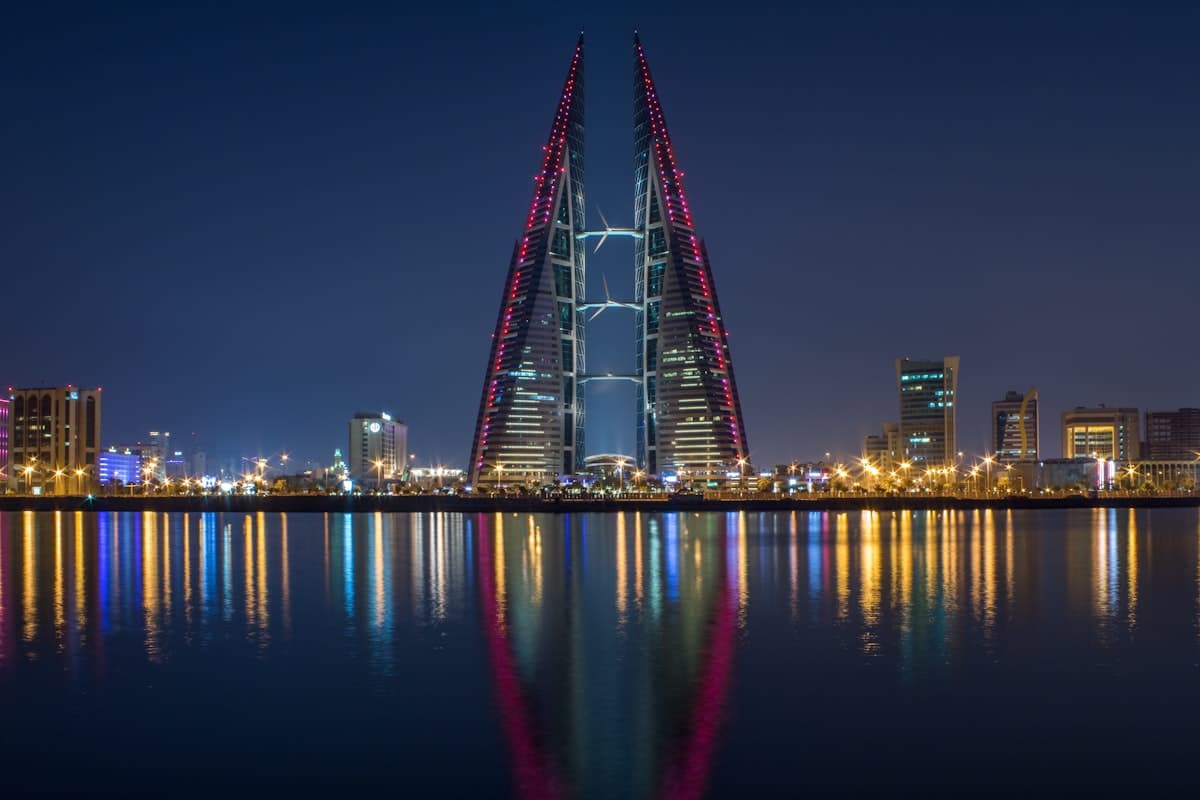
Best time to visit
November to April
Main airport
Bahrain BAH (BAH)
Discover
Top Things to Do in Manama
Culture
Al Fateh Grand Mosque
The Al Fateh Grand Mosque in Manama is one of the world's largest mosques, encompassing 6,500 square metres and accommodating more than 7,000 worshippers beneath a fibreglass dome weighing over 54 tonnes. Named in honour of Ahmed Al Fateh, the first Al Khalifa ruler of Bahrain, the interior is appointed with Italian marble flooring, an Austrian chandelier, and teak doors bearing Kufic calligraphy. Visitors of all faiths are welcomed on guided tours Saturday through Thursday, with abayas and headscarves available at the entrance for those who need them.
Culture
Bahrain National Museum
The Bahrain National Museum, opened in 1988 on the Manama waterfront, is the largest public museum in the country and traces over 6,000 years of island history across halls dedicated to the Dilmun civilisation, Islamic heritage, and Bahrain's pre-oil cultural life. Highlights include Dilmun seals and pottery from regional excavations, a reconstructed burial mound transported from the desert, and a natural history hall that maps the archipelago's ecology. The building itself, designed with traditional Gulf architectural references, overlooks the bay and stands adjacent to the National Theatre.
Beyond the City
Day Trips from Manama
UNESCO World HeritageHistory
Qal'at al-Bahrain
Qal'at al-Bahrain, a UNESCO World Heritage Site since 2005, is an artificial mound built up over seven archaeological layers spanning roughly 4,300 years, from the Dilmun civilisation through Kassite, Greek, Persian, and Portuguese occupation to the eighteenth century. Excavations since 1954 have revealed the oldest fortification in the Gulf region, along with the remains of a Dilmun-era city and Portuguese fort that crowns the site. A modern museum beside the mound presents finds from the digs and contextualises the island's role as a prosperous trade hub at the centre of ancient Gulf commerce.
UNESCO World Heritage
Wise
Your bank marks up every USD you spend in Bahrain. Wise doesn't.
- No foreign transaction fees
- Free ATM withdrawals up to your limit
- Pay in local currency at the real rate
4.8 ★ App Store·4.8 ★ Google Play
Airalo eSIM
Your phone plan was built for home. This one was built for Bahrain.
- No SIM swapping
- No data roaming charges
- Active in minutes
4.7 ★ App Store·4.6 ★ Google Play
Plan Your Trip
Getting Around Manama
Tours, stays, transfers, and flights — curated partner options are on the way.
Tours & Activities
Skip-the-line tickets, guided tours, and day experiences — curated partner options are on the way.
Coming soonWhere to Stay
Hotels, apartments, and guesthouses across every neighbourhood — booking options are on the way.
Coming soonAirport Transfers
Private and shared rides between the airport and the city centre — partner options are on the way.
Coming soonFlights
Compare fares from hundreds of airlines to find the best route in — search options are on the way.
Coming soonTravel Guide
Frequently Asked Questions About Visiting Bahrain
Entry requirements vary by passport. Check the requirements for your specific passport on the Bahrain page at Yoogo.
Bahrain uses the Bahraini Dinar (BHD), one of the world's highest-valued currencies, divided into 1,000 fils. Credit and debit cards are widely accepted in hotels, restaurants, and shops across Manama and other major areas, though carrying some cash is useful for smaller vendors, taxis, and markets.
Bahrain is generally considered one of the safer countries in the Middle East, with low rates of petty crime and violent crime towards visitors. Travellers should remain alert to the possibility of civil unrest, avoid large public gatherings or demonstrations, and monitor local news and their home government's travel advisories throughout their stay.
Ride-hailing apps including Uber and Careem operate across the island and offer a straightforward, metered alternative to negotiating fares. An air-conditioned public bus network operated by the Bahrain Public Transport Company connects Manama, Muharraq, Riffa, and Isa Town, with a rechargeable GO Card available at the airport and main terminals. Renting a car is a practical option for reaching sites outside the capital such as the Tree of Life and Dilmun Burial Mounds.
The most comfortable period for sightseeing is November through March, when daytime temperatures range roughly 15–25 degrees Celsius and outdoor exploration is pleasant. The summer months of June through September bring extreme heat and high humidity, which can make outdoor activities challenging, though hotel rates are typically lower during this period.
Arabic is the official language, with Gulf Arabic the primary spoken dialect. English is widely understood in tourist areas, hotels, restaurants, and shops throughout Manama and Muharraq, making it straightforward for English-speaking visitors to navigate daily life without Arabic language skills.
No vaccinations are required for entry to Bahrain unless arriving from a country with a risk of yellow fever transmission, in which case proof of yellow fever vaccination may be required. Hepatitis A, Hepatitis B, and typhoid vaccinations are commonly recommended by travel health clinicians, and travellers should ensure routine immunisations are up to date before departure.
Tipping is customary but not compulsory; a gratuity of around 10–15 per cent is appreciated in restaurants where a service charge has not already been added to the bill. Small tips for hotel porters, housekeeping staff, and taxi drivers are considered a polite gesture, though not obligatory.