←Bhutan travel guide
Thimphu District, Bhutan
Thimphu
A Himalayan capital where monasteries meet mountain markets
CultureHistory & HeritageScenic Views
Thimphu is Bhutan's capital and largest city, set in a broad river valley at around 2,300 metres, where traditional whitewashed architecture sits alongside the seat of government. The streets wind past the great Buddha Dordenma statue, the fortress-monastery of Tashichho Dzong, and a weekly farmers market that draws traders from across the country.
Check Bhutan visa requirements →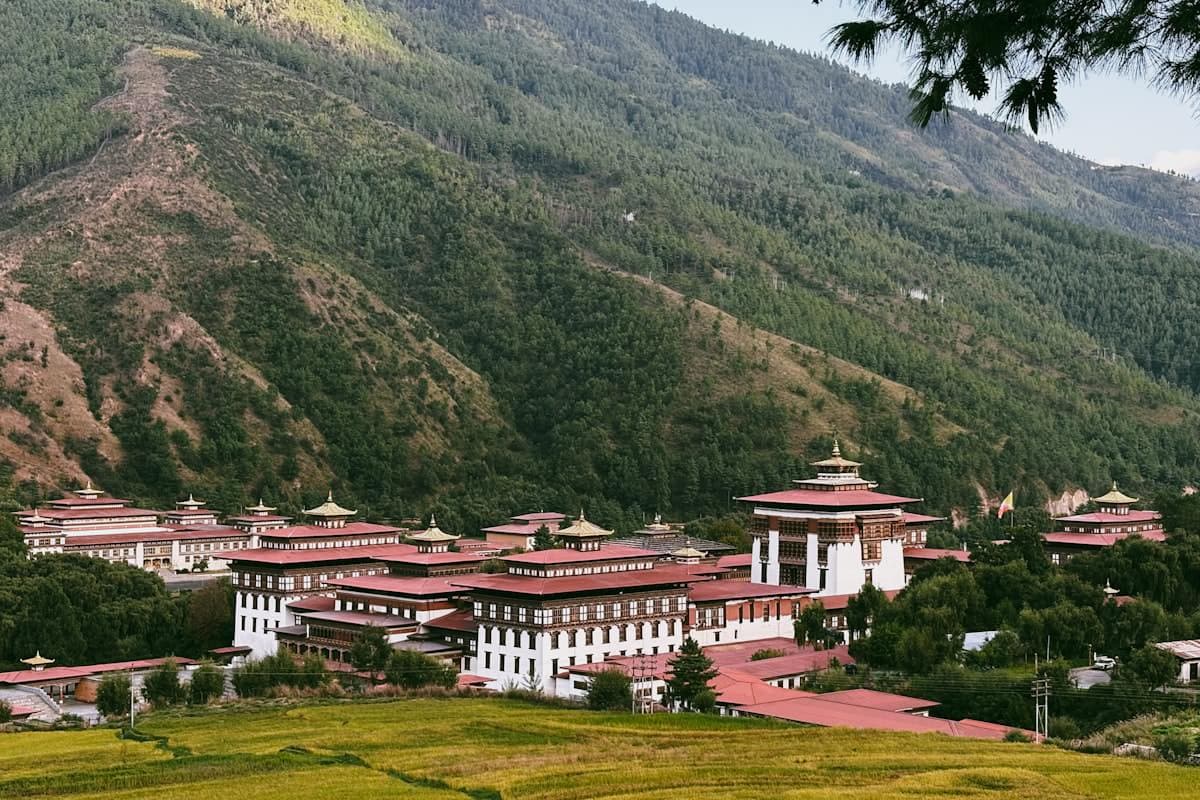
Best time to visit
March to May and September to November
Region
Thimphu District
Main airport
Paro Airport (PBH)
Discover
Top Things to Do in Thimphu
Culture
Buddha Dordenma
The Buddha Dordenma is a 54-metre bronze and gilded statue of Shakyamuni Buddha seated on a hilltop above Thimphu's southern approach, making it one of the largest sitting Buddha statues in the world. Completed in 2015, it was built to fulfil an ancient prophecy and contains 125,000 smaller gilded Buddha figures within its interior. The surrounding parkland offers sweeping views across the capital and the valley below.
History
Tashichho Dzong
Tashichho Dzong is a large white-walled fortress-monastery on the north bank of the Wang Chhu river in Thimphu, serving simultaneously as the seat of Bhutan's government and the summer residence of the central monastic body. First established in 1641 and substantially rebuilt in the 1960s, it houses the throne room and offices of the King, the national secretariat, and several ministries. The dzong's golden rooftops and manicured gardens are particularly striking when illuminated at dusk.
Wise
Your bank marks up every USD you spend in Bhutan. Wise doesn't.
- No foreign transaction fees
- Free ATM withdrawals up to your limit
- Pay in local currency at the real rate
4.8 ★ App Store·4.8 ★ Google Play
Airalo eSIM
Your phone plan was built for home. This one was built for Bhutan.
- No SIM swapping
- No data roaming charges
- Active in minutes
4.7 ★ App Store·4.6 ★ Google Play
Plan Your Trip
Getting Around Thimphu
Tours, stays, transfers, and flights — curated partner options are on the way.
Tours & Activities
Skip-the-line tickets, guided tours, and day experiences — curated partner options are on the way.
Coming soonWhere to Stay
Hotels, apartments, and guesthouses across every neighbourhood — booking options are on the way.
Coming soonAirport Transfers
Private and shared rides between the airport and the city centre — partner options are on the way.
Coming soonFlights
Compare fares from hundreds of airlines to find the best route in — search options are on the way.
Coming soonTravel Guide
Frequently Asked Questions About Visiting Bhutan
Entry requirements vary by passport. Check the requirements for your specific passport on the Bhutan page at Yoogo.
Bhutan's official currency is the Ngultrum (BTN), which is pegged at parity to the Indian Rupee, and both are widely accepted throughout the country. Credit and debit cards are accepted at larger hotels and some restaurants in Thimphu and Paro, but cash is essential for smaller towns, rural areas, and monastery entrance fees. It is advisable to carry sufficient Ngultrum or Indian Rupees for day-to-day expenses outside the main tourist centres.
Bhutan consistently ranks as one of Asia's safest travel destinations, with violent crime being extremely rare and petty theft uncommon by regional standards. The country's mandatory guided-tour structure means visitors travel with a licensed guide at all times, which removes many of the navigational and scam-related concerns found elsewhere. The more significant risks for travellers are altitude sickness at higher elevations and mountain road conditions on narrow winding highways.
Most international visitors travel by private car or minibus arranged through their licensed tour operator, which is the standard mode of intercity transport under Bhutan's tourism model. Public buses connect major towns such as Thimphu, Paro, and Punakha, and taxis are available in urban centres, though fares are not always metered. Limited domestic flights operated by Druk Air and Bhutan Airlines link Paro with Bumthang, Gelephu, and Yongphula, saving many hours of mountain driving.
The two most popular seasons are autumn (October to November) and spring (March to May), both offering clear skies, pleasant temperatures, and the best conditions for trekking and sightseeing. Autumn is generally considered the prime season, with crisp mountain air, excellent visibility of the high Himalayan peaks, and some of Bhutan's most vibrant festivals taking place. The monsoon months of June to August bring heavy rainfall that can affect road access and obscure mountain views, while winters are cold but clear and quieter.
Dzongkha is the national language of Bhutan, and the country has more than nineteen spoken dialects across its various regions. English is widely understood throughout the tourism sector, as it is the medium of instruction in Bhutanese schools and all government-certified guides are required to speak it fluently. Visitors can expect smooth communication in English at hotels, restaurants, and tourist sites, though basic phrases in Dzongkha are warmly appreciated by locals.