←Guyana travel guide
Demerara-Mahaica, Guyana
Georgetown
Colonial wooden architecture where canals meet the Atlantic coast
ArchitectureCultureHistory & Heritage
Georgetown sits on Guyana's Atlantic coast, its wide avenues lined with stilted 19th-century wooden houses shading a grid of Dutch-built canals. The city holds some of the finest British colonial architecture in South America, from the Gothic spire of St. George's Cathedral to the cast-iron clock tower of Stabroek Market.
Check Guyana visa requirements →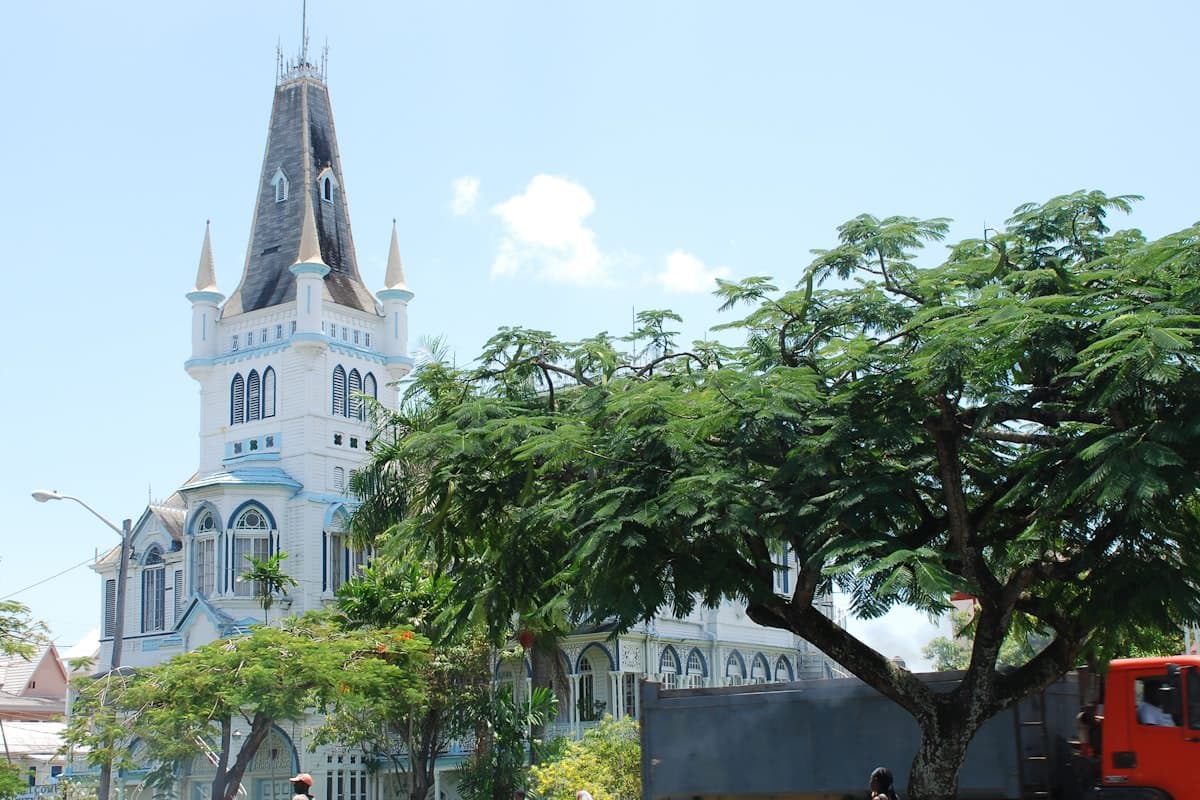
Best time to visit
August to April (dry seasons)
Region
Demerara-Mahaica
Main airport
Georgetown (GEO)
Discover
Top Things to Do in Georgetown
History
St. George's Cathedral
Completed in 1892 to a design by Sir Arthur Blomfield, St. George's Cathedral in Georgetown is a Gothic Revival structure built almost entirely from locally sourced greenheart timber, rising to 43.5 metres. It stood for over a century as the tallest wooden church in the world and remains among the tallest wooden religious buildings anywhere. The cathedral's interior is a quiet, light-filled space whose intricately crafted wooden columns and vaulting demonstrate the exceptional properties of Guyana's native hardwood.
Culture
Stabroek Market
Stabroek Market has anchored commercial life in Georgetown since the late 18th century, and its current Victorian cast-iron structure, completed in 1881, is one of the most recognisable buildings in the country. A four-faced clock tower rises 18 metres above an enormous hall where hundreds of stalls offer fresh produce, spices, local crafts, and street food. The market is listed by the National Trust of Guyana as a key monument and gives visitors an immediate, immersive introduction to the rhythms of everyday Guyanese life.
Beyond the City
Day Trips from Georgetown
Nature
Kaieteur Falls
Kaieteur Falls drops 226 metres over the edge of a Pakaraima sandstone plateau on the Potaro River, making it one of the world's most powerful single-drop waterfalls by the combined measure of height and volume. The surrounding Kaieteur National Park protects ancient rainforest where golden poison-dart frogs cling to bromeliads and Guiana cock-of-the-rock birds flash through the mist. Most visitors arrive by small charter flight, stepping directly into views that place the cascade in breathtaking scale against an unbroken forest canopy.
Nature
Iwokrama Rainforest
Iwokrama is a protected one-million-acre block of primary rainforest in central Guyana, managed jointly by the Guyanese government and the Commonwealth for conservation and sustainable forestry. Its canopy walkway stretches 154 metres across suspension bridges up to 30 metres above the forest floor, offering close encounters with red howler monkeys, two-toed sloths, and a remarkable diversity of bird life including the harpy eagle. The forest is also regarded as one of the best places on the continent to spot a wild jaguar.
Wise
Your bank marks up every USD you spend in Guyana. Wise doesn't.
- No foreign transaction fees
- Free ATM withdrawals up to your limit
- Pay in local currency at the real rate
4.8 ★ App Store·4.8 ★ Google Play
Airalo eSIM
Your phone plan was built for home. This one was built for Guyana.
- No SIM swapping
- No data roaming charges
- Active in minutes
4.7 ★ App Store·4.6 ★ Google Play
Plan Your Trip
Getting Around Georgetown
Tours, stays, transfers, and flights — curated partner options are on the way.
Tours & Activities
Skip-the-line tickets, guided tours, and day experiences — curated partner options are on the way.
Coming soonWhere to Stay
Hotels, apartments, and guesthouses across every neighbourhood — booking options are on the way.
Coming soonAirport Transfers
Private and shared rides between the airport and the city centre — partner options are on the way.
Coming soonFlights
Compare fares from hundreds of airlines to find the best route in — search options are on the way.
Coming soonTravel Guide
Frequently Asked Questions About Visiting Guyana
Entry requirements vary by passport. Check the requirements for your specific passport on the Guyana page at Yoogo.
Guyana's official currency is the Guyanese dollar (GYD), and cash is the dominant form of payment throughout the country. US dollars are widely accepted in Georgetown, though change is typically given in GYD. Credit cards are accepted at a limited number of upscale hotels, car rental agencies, and larger restaurants in the capital, often with a surcharge of 3–5%, and are rarely usable outside Georgetown.
Georgetown experiences higher rates of petty crime such as pickpocketing and bag-snatching, particularly around busy markets and the seawall, and extra care is warranted after dark. Guyana's interior regions, which include most of the country's main tourist destinations such as Kaieteur Falls, Iwokrama, and the Rupununi, are generally considered safe, and the majority of visitors travel there without incident. Travelling with a reputable tour operator and staying alert in urban areas significantly reduces risk.
Within Georgetown, yellow licensed taxis (identifiable by the letter H on their number plates) are the most convenient option, with fares negotiated in advance as there are no meters. Minibuses run fixed coastal routes at low fares and are the most common form of public transport between towns. Reaching interior destinations such as Kaieteur Falls and Iwokrama typically requires a small charter flight or a combination of road and river travel.
Guyana has two dry seasons: roughly September to November and February to April. These periods offer the most reliable conditions for visiting Kaieteur Falls, exploring rainforest trails, and wildlife watching in the Rupununi. The wet seasons (May to August, and December to January) bring heavy rains that can limit access to interior regions, though they also fill rivers and bring the landscape to vivid life.
English is Guyana's official language and the medium of instruction in schools, making it the only English-speaking country in South America. The majority of the population speaks Guyanese Creole (Creolese) as their everyday language, an English-based creole with African, Indigenous, and South Asian influences. Indigenous Amerindian languages are spoken in interior communities, and you will find some Hindi and Portuguese spoken in specific communities as well.
Yellow fever vaccination is strongly recommended for all travellers aged nine months and older, and a valid certificate may be required if arriving from a country with yellow fever risk. Malaria prophylaxis is advised for travel to interior regions, though the risk in coastal Georgetown is considered low. Hepatitis A and typhoid vaccinations are also commonly recommended; consult a travel health clinic well before your departure.