←Kuwait travel guide
Al Asimah Governorate, Kuwait
Kuwait City
Gulf skyline and ancient souqs on the Arabian shore
ArchitectureCultureHistory & HeritageShopping
Kuwait City is the capital and beating heart of the country, where glass-fronted towers rise above a waterfront corniche and the old Souq Al-Mubarakiya has traded for well over a century. Visitors find world-class cultural centres, heritage museums, and a dining scene that ranges from traditional Kuwaiti kitchens to international restaurants.
Check Kuwait visa requirements →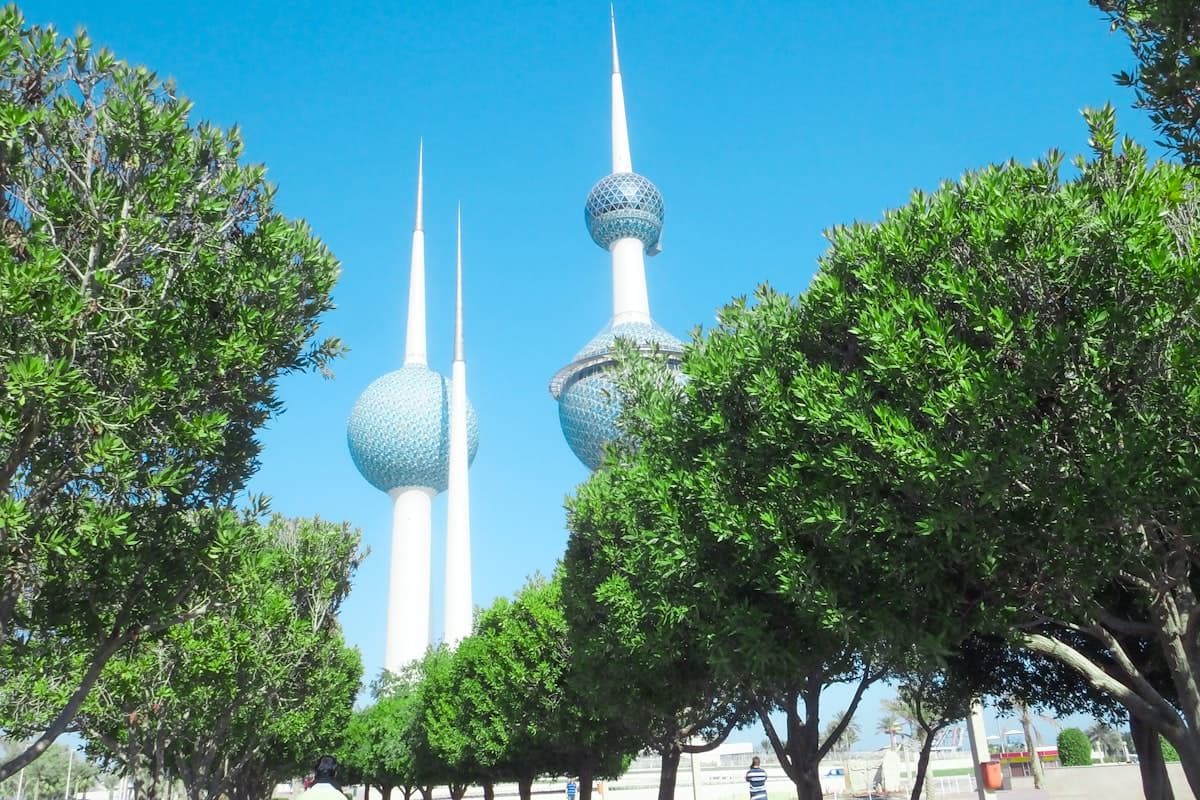
Best time to visit
November to April
Region
Al Asimah Governorate
Main airport
Kuwait KWI (KWI)
Discover
Top Things to Do in Kuwait City
City
Kuwait Towers
Rising above the Arabian Gulf corniche, the Kuwait Towers are the country's most recognised landmark, comprising three slender towers completed in 1979 and adorned with blue, green, and grey enamel tiles inspired by Islamic geometric motifs. The main tower stands 187 metres tall and houses a revolving observation deck at 120 metres that completes a full rotation every 30 minutes, offering panoramic views across Kuwait City and the Gulf. A restaurant and reception halls occupy the twin globe structures, making the complex both a working facility and a striking example of mid-century modernist design.
Culture
Souq Al-Mubarakiya
Established in the late nineteenth century and named after Amir Sheikh Mubarak Al-Sabah, this sprawling traditional market in central Kuwait City is one of the oldest in the country, predating the oil era and once serving as the main hub for trade with India, Persia, and the broader Middle East. Stalls and covered lanes sell Persian carpets, oud and musk perfumes, gold jewellery, spices, dates, and traditional Kuwaiti clothing alongside fresh produce and seafood. The souq was damaged during the 1990 Iraqi invasion and subsequently restored, retaining its original low-rise architecture and busy communal character.
Wise
Your bank marks up every USD you spend in Kuwait. Wise doesn't.
- No foreign transaction fees
- Free ATM withdrawals up to your limit
- Pay in local currency at the real rate
4.8 ★ App Store·4.8 ★ Google Play
Airalo eSIM
Your phone plan was built for home. This one was built for Kuwait.
- No SIM swapping
- No data roaming charges
- Active in minutes
4.7 ★ App Store·4.6 ★ Google Play
Plan Your Trip
Getting Around Kuwait City
Tours, stays, transfers, and flights — curated partner options are on the way.
Tours & Activities
Skip-the-line tickets, guided tours, and day experiences — curated partner options are on the way.
Coming soonWhere to Stay
Hotels, apartments, and guesthouses across every neighbourhood — booking options are on the way.
Coming soonAirport Transfers
Private and shared rides between the airport and the city centre — partner options are on the way.
Coming soonFlights
Compare fares from hundreds of airlines to find the best route in — search options are on the way.
Coming soonTravel Guide
Frequently Asked Questions About Visiting Kuwait
Entry requirements vary by passport. Check the requirements for your specific passport on the Kuwait page at Yoogo.
Kuwait uses the Kuwaiti dinar (KWD), consistently one of the world's highest-valued currencies, so carry small denominations for markets and taxis. Credit and debit cards are widely accepted in hotels, shopping malls, and restaurants, while cash remains preferred at traditional souqs and smaller establishments.
Kuwait is generally considered a safe destination with low rates of street crime and a stable political environment. Standard precautions apply, such as keeping valuables secure and being aware of your surroundings, and it is advisable to monitor your government's travel advisory before departure.
Kuwait has no metro system yet, so the main options are taxis, app-based ride services such as Careem, and public buses operated by the Kuwait Public Transport Company. Renting a car is practical as the road network is modern and driving is on the right, though traffic in Kuwait City can be heavy during peak hours.
The most comfortable period for visiting is November through March, when temperatures sit between roughly 10°C and 25°C and outdoor sightseeing is pleasant. Summers (June to September) bring extreme heat that regularly exceeds 45°C, making outdoor activities difficult during midday hours.
Arabic is the official language, but English is widely spoken and understood across hotels, restaurants, shopping centres, and tourist attractions, with most public signage presented in both languages. Taxi drivers may have limited English, so having your destination written in Arabic can be useful.
No vaccinations are legally required for most travellers entering Kuwait, though it is advisable to ensure routine immunisations are up to date and to consider vaccinations for hepatitis A, typhoid, and hepatitis B depending on your itinerary and health history. Consult a travel health clinic or your GP at least four to six weeks before departure for personalised advice.
Tipping is appreciated but not obligatory. Many hotels and restaurants add a 10 to 15 per cent service charge to bills, in which case an additional tip is not expected, though rounding up or leaving a small amount for attentive service is welcomed.
Kuwait has strong mobile coverage through three main networks (Zain, Ooredoo, and STC), all of which offer 4G and 5G across urban areas. Travellers with compatible devices can purchase an eSIM before departure through providers such as Airalo, offering a convenient way to stay connected from the moment of arrival.