←North Korea travel guide
Pyongyang, North Korea
Pyongyang
Grand monuments and wide boulevards in the DPRK capital
ArchitectureCultureHistory & Heritage
Pyongyang is the capital and largest city of North Korea, shaped by decades of monumental architecture including the Tower of the Juche Idea, the Mansudae Grand Monument, and the vast Kim Il Sung Square. Wide tree-lined avenues, the Taedong River, and a network of deep underground metro stations give the city a scale and character unlike anywhere else in East Asia.
Check North Korea visa requirements →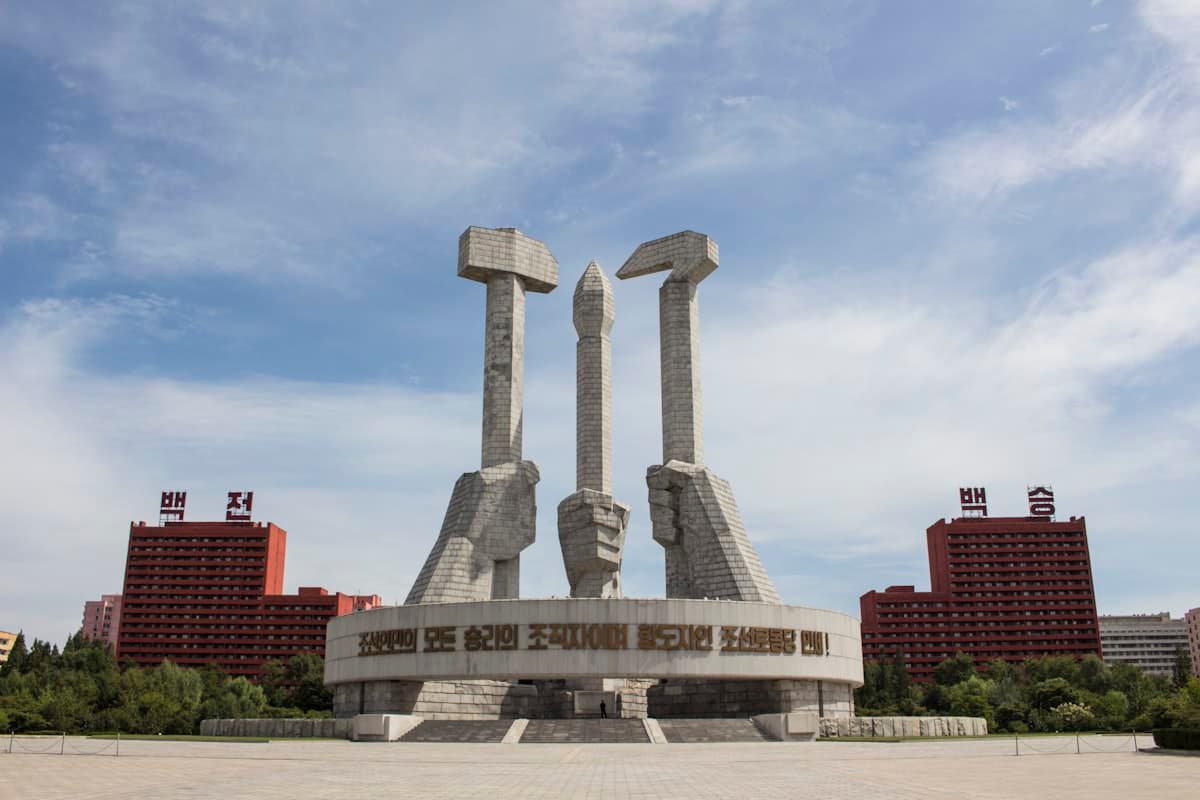
Best time to visit
April to June and September to October
Region
Pyongyang
Main airport
Pyongyang (FNJ)
Discover
Top Things to Do in Pyongyang
Culture
Mansudae Grand Monument
The Mansudae Grand Monument on Mansu Hill in central Pyongyang comprises two 22-metre bronze statues of former leaders Kim Il Sung and Kim Jong Il, flanked by two sweeping mosaic murals and a 200-metre tableau of revolutionary sculptural figures. The site functions as the symbolic centre of North Korean public life, and visitors traditionally bow and present flowers at the base of the statues. The surrounding hilltop park affords a panoramic view across the capital.
History
Tower of the Juche Idea
Rising 170 metres above the eastern bank of the Taedong River, the Tower of the Juche Idea was completed in 1982 to mark the 70th birthday of Kim Il Sung and is officially the world's tallest granite monument, surpassing the Washington Monument by one metre. Its white stone column is formed from 25,550 blocks, representing each day of Kim Il Sung's life, and is crowned by a 20-metre illuminated metal torch. Visitors can ascend by lift to a viewing platform offering wide views across Pyongyang and the river below.
Beyond the City
Day Trips from Pyongyang
UNESCO World HeritageHistory
Complex of Koguryo Tombs
Designated a UNESCO World Heritage Site in 2004, this collection of ancient burial mounds from the Koguryo Kingdom (1st century BC to 7th century AD) is concentrated around Pyongyang and in South Hwanghae Province. The tombs feature large earthen mounds covering stone burial chambers whose walls are decorated with vivid paintings depicting court life, hunting scenes, and mythological guardians including the White Tiger and Azure Dragon. The Anak Tomb No. 3 is among the most celebrated, with its detailed murals offering one of the finest surviving records of ancient Korean aristocratic life.
Culture
Wise
Your bank marks up every USD you spend in North Korea. Wise doesn't.
- No foreign transaction fees
- Free ATM withdrawals up to your limit
- Pay in local currency at the real rate
4.8 ★ App Store·4.8 ★ Google Play
Airalo eSIM
Your phone plan was built for home. This one was built for North Korea.
- No SIM swapping
- No data roaming charges
- Active in minutes
4.7 ★ App Store·4.6 ★ Google Play
Plan Your Trip
Getting Around Pyongyang
Tours, stays, transfers, and flights — curated partner options are on the way.
Tours & Activities
Skip-the-line tickets, guided tours, and day experiences — curated partner options are on the way.
Coming soonWhere to Stay
Hotels, apartments, and guesthouses across every neighbourhood — booking options are on the way.
Coming soonAirport Transfers
Private and shared rides between the airport and the city centre — partner options are on the way.
Coming soonFlights
Compare fares from hundreds of airlines to find the best route in — search options are on the way.
Coming soonTravel Guide
Frequently Asked Questions About Visiting North Korea
Entry requirements vary by passport. Check the requirements for your specific passport on the North Korea page at Yoogo.
The official currency is the North Korean won (KPW), though foreigners are generally required to use US dollars, euros, or Chinese yuan for purchases in tourist-facing shops and restaurants. North Korea operates as a fully cash-based economy for visitors, with no ATMs or credit card facilities available to foreign travellers.
North Korea is one of the most tightly controlled destinations in the world, and all visitors travel on strictly guided itineraries with government-assigned minders. The rules of conduct are rigidly enforced, and any perceived disrespect towards the country's leadership or political symbols can have serious consequences. Travellers should familiarise themselves with current government travel advisories before making plans.
Independent travel is not permitted, and all transport is arranged by the official tour operator and government-assigned guides. Within Pyongyang, visitors may travel by coach, the city's deep-level metro (one of the world's deepest subway systems), and sometimes by tram. Intercity travel to sites such as Kaesong, Wonsan, or Mount Paektu is conducted by coach or chartered flights as part of the organised itinerary.
Spring (April to May) and autumn (September to October) are widely considered the best periods to visit, offering mild temperatures, low rainfall, and clear skies well suited to sightseeing and outdoor excursions. Autumn is particularly scenic as the country's forested mountains turn vivid shades of red, orange, and gold. Summer brings higher humidity and the risk of monsoon rains, while winter is bitterly cold with temperatures regularly falling well below freezing.
Korean is the sole official language, spoken throughout the country in its northern dialect, which differs in vocabulary and pronunciation from the dialect spoken in South Korea. English is not widely understood among the general population, though government-assigned tour guides often speak English or Mandarin Chinese, providing interpretation throughout the visit.
The US Centers for Disease Control and Prevention and most national health authorities recommend ensuring routine vaccinations are up to date before travel, with additional consideration given to hepatitis A, hepatitis B, typhoid, Japanese encephalitis, and rabies depending on the itinerary and activities planned. Medical facilities in North Korea are extremely limited by international standards, and travellers are strongly advised to carry a comprehensive supply of any prescription medication and a well-stocked travel medical kit. Tap water should not be consumed; stick to bottled or boiled water throughout the trip.