←All destinations
Travel Guide
Visiting Samoa
Select your passport to instantly check if you need a visa.
Discover
Top Attractions in Samoa
The most iconic and unmissable experiences this country has to offer.
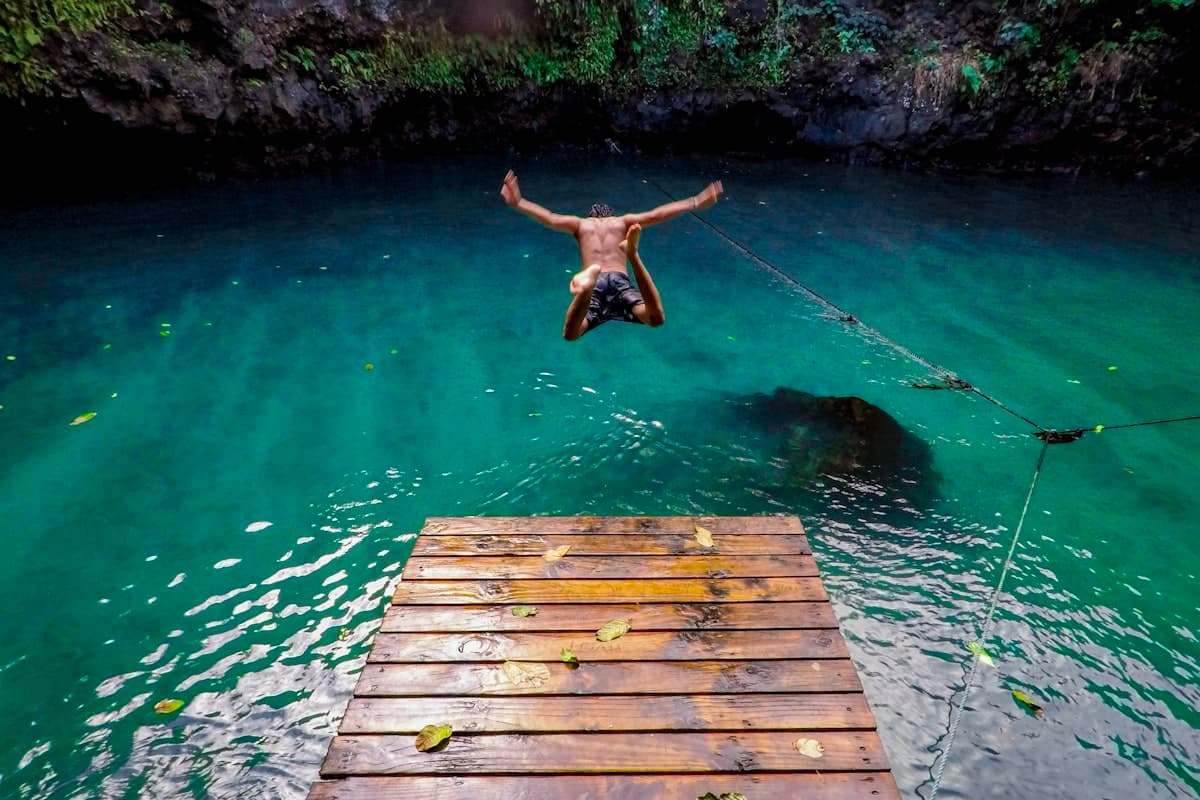
To Sua Ocean Trench
To Sua, meaning 'giant swimming hole' in Samoan, is a collapsed lava tube on Upolu's south coast that has filled with turquoise ocean water to a depth of around 30 metres. Visitors descend a long wooden ladder to reach the pool, which connects to the open sea through an underwater cave system. The surrounding garden of tropical plants and the vivid colour of the water make it one of the most photographed natural sites in the Pacific.
Robert Louis Stevenson Museum (Vailima)
The Victorian mansion of Villa Vailima, set on forested slopes south of Apia, was the home of Scottish author Robert Louis Stevenson from 1890 until his death in 1894, and today operates as a carefully restored museum. Original personal effects, books, and period furnishings fill the restored rooms, and a guided Tomb Trail leads through rainforest to Stevenson's grave on the summit of Mount Vaea. The estate offers one of the more distinctive literary and colonial heritage experiences in the Pacific.
Pulemelei Mound
The Pulemelei Mound on Savai'i is the largest ancient structure in Polynesia, a stepped basalt-stone platform measuring approximately 65 by 60 metres at its base and rising to around 12 metres in height. Built between roughly 1100 and 1400 AD, its exact purpose remains a subject of scholarly debate, with ceremonial and astronomical functions among the leading theories. The site sits within a rainforest setting in the Letolo Plantation, lending it an atmosphere of genuine discovery.
Wise
Your bank marks up every USD you spend in Samoa. Wise doesn't.
- No foreign transaction fees
- Free ATM withdrawals up to your limit
- Pay in local currency at the real rate
4.8 ★ App Store·4.8 ★ Google Play
Airalo eSIM
Your phone plan was built for home. This one was built for Samoa.
- No SIM swapping
- No data roaming charges
- Active in minutes
4.7 ★ App Store·4.6 ★ Google Play
Where to Go
Top Cities to Visit in Samoa
Health & Safety
Health & Emergency Info
Before You Travel
Before you travel check that: your destination can provide the healthcare you may need you have appropriate travel insurance for local treatment or unexpected medical evacuation This is particularly important if you have a health condition or are pregnant. Emergency medical number Call 911 and ask for an ambulance. Contact your insurance company quickly if you’re referred to a medical facility for treatment. Vaccine recommendations and health risks At least 8 weeks before your trip: check the latest vaccine recommendations for Samoa see where to get vaccines and whether you have to pay on the
Full health advice (FCDO) →Emergency Numbers
Police911
Ambulance911
Fire911
Health information sourced from UK FCDO. Always consult a travel health professional before departure.
Practical Info
Travel Essentials
Travel Guide
Frequently Asked Questions About Visiting Samoa
Entry requirements vary by passport. Check the requirements for your specific passport on the Samoa page at Yoogo.
Samoa's currency is the Samoan Tala (WST), divided into 100 sene. Credit and debit cards are not universally accepted, so carrying sufficient cash is advisable, particularly for village entry fees, markets, and smaller eateries. ATMs can be found at Faleolo International Airport, in Apia, and in Salelologa on Savai'i.
Samoa has a low violent crime rate and is generally considered one of the safer destinations in the Pacific. Petty theft, particularly in and around Apia, is the most commonly reported concern affecting visitors. Standard precautions such as avoiding unlit areas at night and keeping valuables out of sight apply.
On Upolu, buses, taxis, and rental cars serve most tourist areas, with taxis from Faleolo Airport to Apia costing approximately WST 60. A daily passenger and car ferry connects Upolu and Savai'i; booking vehicle spaces in advance through Shipping House in Apia is recommended. Foreign visitors must obtain a temporary Samoan driving licence, available from rental companies, Samoa Post, or the Land Transport Authority.
The dry season from May to October offers the most settled weather, with lower humidity and reduced rainfall, making it the most popular time to visit. The wet season runs from November to April, with December to March seeing the heaviest rainfall and the highest risk of tropical cyclones. Temperatures remain warm throughout the year, typically ranging from 24 to 30 degrees Celsius.
Samoan and English are both official languages. English is widely spoken in Apia, at resorts, and in most business contexts, so communication is straightforward for English-speaking visitors. Learning a few words of Samoan, such as 'talofa' (hello) and 'fa'afetai' (thank you), is appreciated by locals.
Travellers are generally advised to be up to date with routine vaccinations including MMR, tetanus, and hepatitis A and B before visiting Samoa. Dengue fever and Zika virus are present in the country, so mosquito repellent and protective clothing are recommended. Consult a travel health clinic or GP at least six weeks before departure for personalised advice.
Tipping is not a traditional practice in Samoa and is not expected in most settings. A small tip for tour guides, particularly on group excursions, is considered a genuine gesture of appreciation rather than an obligation. Hotels and restaurants do not routinely add service charges to bills.