←San Marino travel guide
City in San Marino
City of San Marino
Medieval towers above the Adriatic, oldest republic on earth
ArchitectureHistory & HeritageScenic Views
Perched atop Monte Titano at 750 metres, the City of San Marino is the capital of the world's oldest surviving republic, its UNESCO-listed historic centre woven from cobblestone contrade and centuries-old stone fortifications. The Three Towers crown the mountain's peaks, connected by the Passo delle Streghe, a walkway that reveals sweeping views across the Italian peninsula and, on clear days, out to the Adriatic coast.
Check San Marino visa requirements →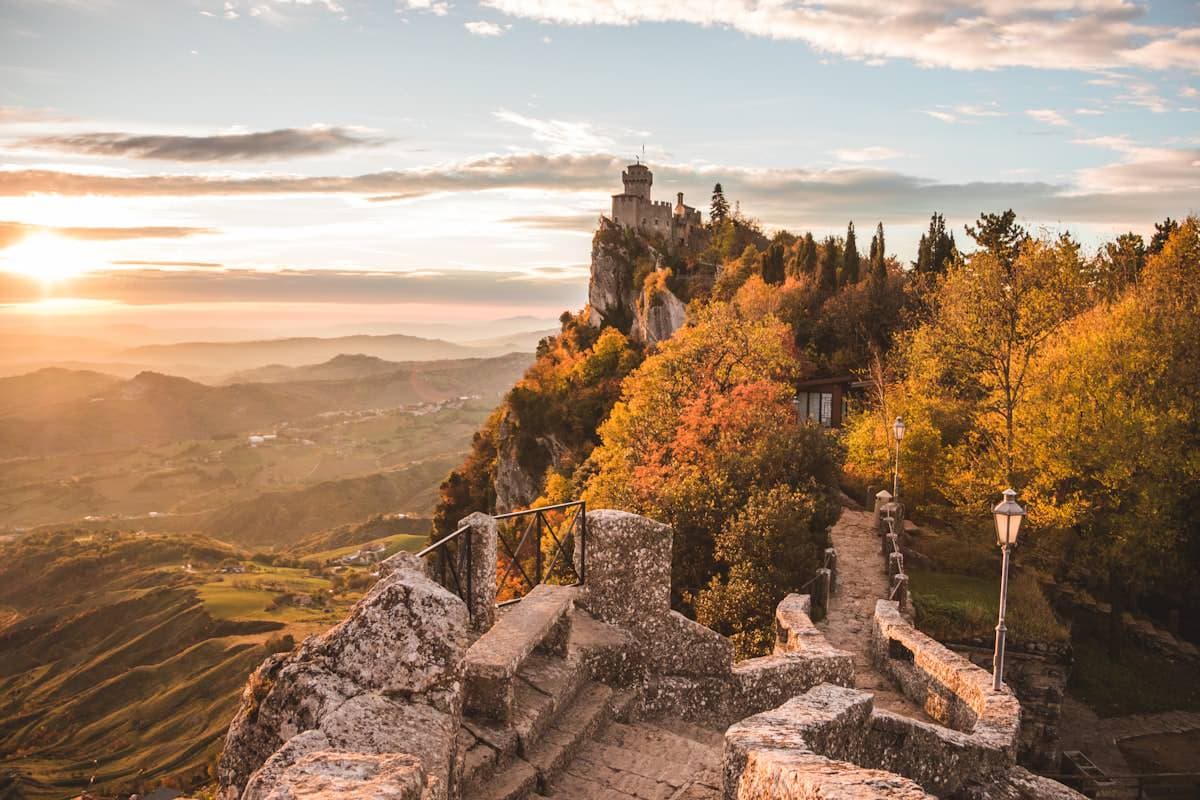
Best time to visit
May to September
Main airport
Rimini RMI (RMI)
Discover
Top Things to Do in City of San Marino
UNESCO World HeritageHistory
Three Towers of San Marino
The Guaita, Cesta, and Montale towers stand on the three peaks of Monte Titano and have defined the San Marino skyline since the Middle Ages, appearing on the national flag and coat of arms. The Guaita, built in the 11th century, is the oldest and most recognisable, while the Cesta on the highest summit now houses a museum of ancient weapons with some 700 examples spanning the 13th to 19th centuries. The walkway connecting the towers, the Passo delle Streghe, offers uninterrupted panoramic views across the Apennines and the Adriatic plain.
UNESCO World HeritageHistory
Wise
Your bank marks up every USD you spend in San Marino. Wise doesn't.
- No foreign transaction fees
- Free ATM withdrawals up to your limit
- Pay in local currency at the real rate
4.8 ★ App Store·4.8 ★ Google Play
Airalo eSIM
Your phone plan was built for home. This one was built for San Marino.
- No SIM swapping
- No data roaming charges
- Active in minutes
4.7 ★ App Store·4.6 ★ Google Play
Plan Your Trip
Getting Around City of San Marino
Tours, stays, transfers, and flights — curated partner options are on the way.
Tours & Activities
Skip-the-line tickets, guided tours, and day experiences — curated partner options are on the way.
Coming soonWhere to Stay
Hotels, apartments, and guesthouses across every neighbourhood — booking options are on the way.
Coming soonAirport Transfers
Private and shared rides between the airport and the city centre — partner options are on the way.
Coming soonFlights
Compare fares from hundreds of airlines to find the best route in — search options are on the way.
Coming soonTravel Guide
Frequently Asked Questions About Visiting San Marino
Entry requirements vary by passport. Check the requirements for your specific passport on the San Marino page at Yoogo.
San Marino uses the euro (EUR), and prices are often slightly lower than in neighbouring Italy because the republic does not levy VAT. Card payments are accepted in most hotels, restaurants, and larger shops, though carrying some cash is advisable for smaller vendors and market stalls.
San Marino is consistently rated one of the safest countries in the world, with very low rates of crime. The main hazards are the steep cobblestone streets of the historic centre, which can be slippery, particularly after rain.
Within the capital, the old town is pedestrian-only and best explored on foot, though the streets are steep. A cable car connects the city to Borgo Maggiore below, running every fifteen minutes, and local buses link the nine municipalities. Taxis are available but considerably more expensive than the cable car or bus.
Spring (April to May) and early autumn (September to October) offer the most pleasant conditions, with mild temperatures, good visibility across to the Adriatic, and noticeably fewer visitors than the peak summer months. July and August are the busiest period, with day-tripping crowds and higher accommodation prices, though evenings on the mountain are considerably quieter once tour groups have departed.
Italian is the official language and the mother tongue of all Sammarinese people. English is taught in schools and is understood by many younger residents and those working in the tourism industry, so visitors will generally find basic communication straightforward.
No vaccinations are required for entry to San Marino. The country is a high-income European republic with excellent healthcare infrastructure, and the health risks faced by travellers are the same as those in western Italy. Keeping routine vaccinations, such as MMR and tetanus, up to date is the standard recommendation for travel to any European destination.
Tipping customs follow the same conventions as in Italy. A coperto (cover charge) is typically added to restaurant bills, and an additional tip is not expected, though rounding up the bill or leaving a small amount is a welcome gesture if the service has been good.
San Marino has no domestic mobile network of its own and operates entirely through Italian networks, which provide excellent coverage across the republic, including at the summit of Monte Titano. Any eSIM plan with Italy or broader European coverage will work seamlessly throughout the country, and providers such as Airalo offer convenient options that can be activated before departure.