←Azerbaijan travel guide
Baku, Azerbaijan
Baku
Where ancient walls meet Caspian seafront and flame-lit towers
ArchitectureCultureFood & DrinkHistory & Heritage
Baku, the capital of Azerbaijan, sits on the shores of the Caspian Sea and holds one of the world's most striking contrasts: a UNESCO-listed medieval walled city at the foot of gleaming modern skyscrapers. The Old City's labyrinthine lanes, the Maiden Tower, and the Shirvanshah Palace sit within walking distance of the futuristic Flame Towers and the sweeping Heydar Aliyev Center.
Check Azerbaijan visa requirements →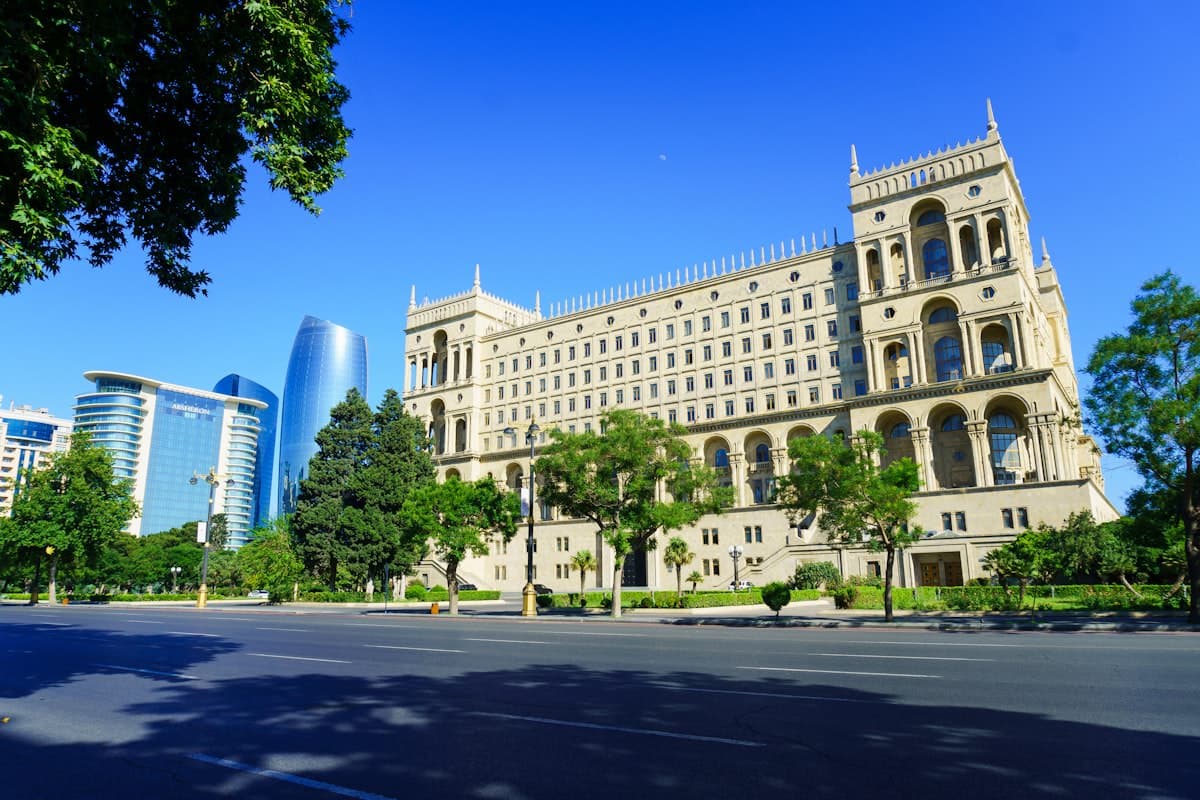
Best time to visit
April to June and September to November
Region
Baku
Main airport
Baku GYD (GYD)
Discover
Top Things to Do in Baku
UNESCO World HeritageHistory
Walled City of Baku (Icherisheher)
The Walled City of Baku is Azerbaijan's most celebrated UNESCO World Heritage Site, enclosing a dense network of narrow lanes, medieval mosques, and caravanserais that have been continuously inhabited since the Palaeolithic period. At its heart stand the Maiden Tower, an enigmatic 12th-century cylindrical structure overlooking the Caspian Sea, and the 15th-century Shirvanshah Palace complex, regarded as one of the finest examples of Azerbaijani medieval architecture. Walking through the old walls rewards visitors with layers of Zoroastrian, Shirvani, Persian, Ottoman, and Russian heritage within a compact area.
Culture
Heydar Aliyev Center
Designed by Iraqi-British architect Zaha Hadid and completed in 2012, the Heydar Aliyev Center is an instantly recognisable Baku landmark whose flowing, curve-driven form famously contains not a single straight line. Spanning 57,500 square metres, the building won the London Design Museum's Design of the Year Award in 2014 and houses permanent galleries on Azerbaijani history alongside rotating exhibitions. The sweeping white exterior is as striking in daylight as at dusk, when it glows against the skyline.
Beyond the City
Day Trips from Baku
UNESCO World HeritageHistory
Gobustan Rock Art Cultural Landscape
Located roughly 60 kilometres south-west of Baku, Gobustan preserves more than 6,000 petroglyphs carved across a dramatic landscape of boulders and rock outcrops, spanning some 40,000 years from the Upper Palaeolithic to the Middle Ages. The UNESCO World Heritage Site depicts hunters, boats, dancers, and animals, offering a vivid record of prehistoric life along the western Caspian shore. A modern on-site museum provides context for the engravings, and a short walk away lies one of the world's largest mud-volcano fields.
Nature
Mud Volcanoes of Gobustan
Wise
Your bank marks up every USD you spend in Azerbaijan. Wise doesn't.
- No foreign transaction fees
- Free ATM withdrawals up to your limit
- Pay in local currency at the real rate
4.8 ★ App Store·4.8 ★ Google Play
Airalo eSIM
Your phone plan was built for home. This one was built for Azerbaijan.
- No SIM swapping
- No data roaming charges
- Active in minutes
4.7 ★ App Store·4.6 ★ Google Play
Plan Your Trip
Getting Around Baku
Tours, stays, transfers, and flights — curated partner options are on the way.
Tours & Activities
Skip-the-line tickets, guided tours, and day experiences — curated partner options are on the way.
Coming soonWhere to Stay
Hotels, apartments, and guesthouses across every neighbourhood — booking options are on the way.
Coming soonAirport Transfers
Private and shared rides between the airport and the city centre — partner options are on the way.
Coming soonFlights
Compare fares from hundreds of airlines to find the best route in — search options are on the way.
Coming soonTravel Guide
Frequently Asked Questions About Visiting Azerbaijan
Entry requirements vary by passport. Check the requirements for your specific passport on the Azerbaijan page at Yoogo.
Azerbaijan uses the Azerbaijani manat (AZN), which cannot be purchased easily outside the country, so plan to exchange money on arrival. Credit and debit cards (Visa and Mastercard) are widely accepted in hotels, restaurants, and larger shops in Baku, though smaller towns and rural areas rely more heavily on cash. ATMs are plentiful in cities and generally accept international cards without charging access fees.
Azerbaijan is generally considered a safe destination for tourists, with low rates of violent crime and a welcoming attitude towards visitors. Petty theft and scams can occur in busy tourist areas, so standard precautions apply. Travellers should monitor official government travel advisories before and during their trip, as the security situation in certain border regions can change.
Baku has an efficient and inexpensive metro system, and taxis (including app-based services such as Bolt) are widely available throughout the capital. Intercity trains and buses connect Baku with major destinations including Ganja and Sheki, though journey times can be long. Car hire is an option for exploring rural areas and mountain regions at your own pace.
Spring (April to June) and autumn (September to October) offer the most comfortable conditions, with mild temperatures, clear skies, and lush landscapes. Baku can become very hot in July and August, while winters in the mountains bring heavy snow. The spring Novruz festival in late March is one of the country's most vibrant cultural events.
Azerbaijani is the official language, and Russian remains widely understood among older residents and in business contexts. English is increasingly spoken by younger people and by hospitality staff in Baku, though it becomes less common in smaller towns and rural areas. Learning a few basic phrases in Azerbaijani is appreciated and often warmly received.
No vaccinations are legally required for entry, but travel health clinics commonly recommend being up to date with hepatitis A, typhoid, and tetanus-diphtheria before visiting. Hepatitis B vaccination is also advisable for longer stays or travellers with particular risk factors. Azerbaijan was declared malaria-free by the WHO in 2023, so no malaria prophylaxis is needed.
Tipping is not obligatory in Azerbaijan, but it is appreciated and becoming more common, particularly in Baku's restaurants and hotels. A tip of around 10 per cent of the bill is a reasonable gesture in sit-down restaurants if service has been good. Taxi drivers do not typically expect tips, though rounding up the fare is a courteous habit.