←All destinations
Travel Guide
Visiting Belarus
Select your passport to instantly check if you need a visa.
Do Not Travel
UK FCDO: Your travel insurance could be invalidated if you travel against advice from the Foreign, Commonwealth & Development Office (FCDO).
Updated 2026-03-19
Discover
Top Attractions in Belarus
The most iconic and unmissable experiences this country has to offer.
UNESCO World Heritage
Mir Castle Complex
Built from 1520 and enlarged through the Renaissance period by the powerful Radziwill family, Mir Castle is one of Belarus's most recognisable landmarks and a UNESCO World Heritage Site. Its five towers blend Gothic, Renaissance, and Baroque elements in a combination that reflects the centuries of change the fortress survived. Today the restored complex houses a hotel, exhibition halls, and a restaurant, and hosts historical festivals with knightly tournaments.
UNESCO World Heritage
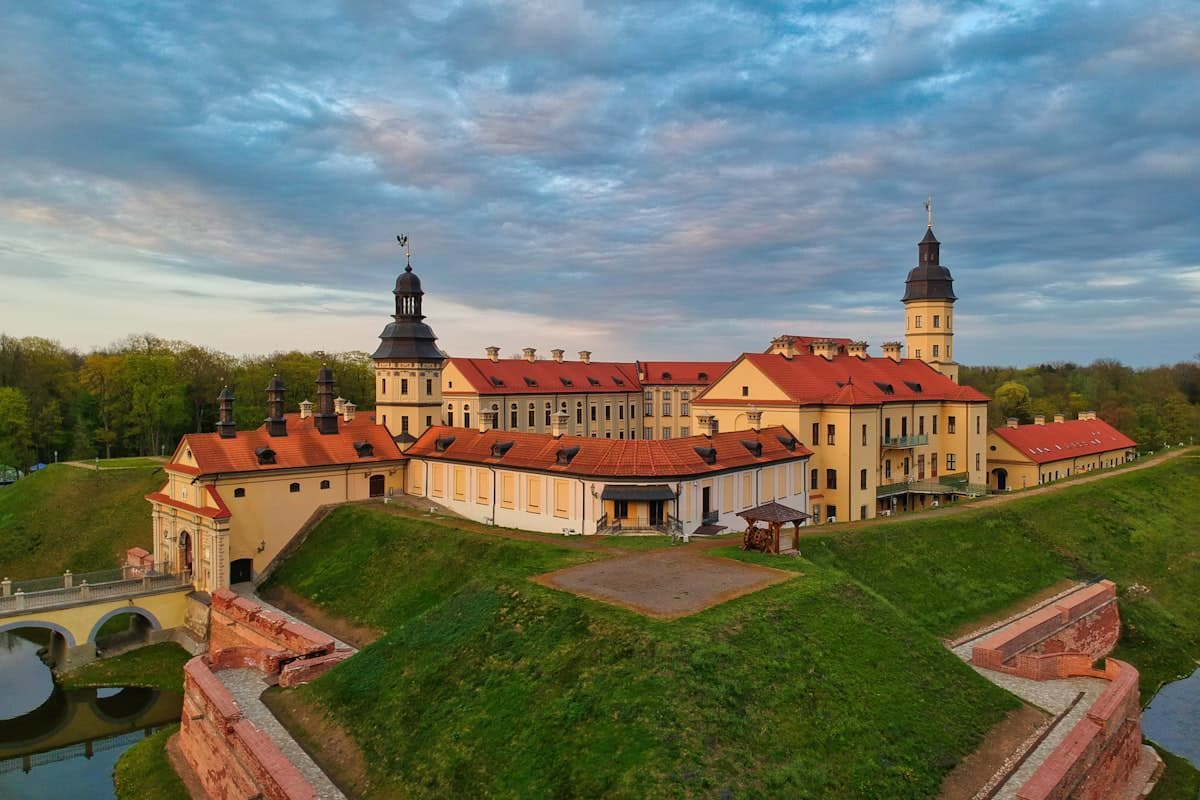
Nesvizh Palace
The Architectural, Residential and Cultural Complex of the Radziwill Family at Nesvizh was inscribed on the UNESCO World Heritage List in 2005 and ranks among the finest palace ensembles in Eastern Europe. Construction began in 1582 to a design attributed to Italian architect Giovanni Maria Bernardoni, and the complex grew over four centuries to encompass ten interconnected buildings arranged around a six-sided courtyard. The surrounding landscape park, lakes, and the attached Corpus Christi Church, which served as the family mausoleum, complete one of Belarus's most rewarding historic sites.
Wise
Your bank marks up every USD you spend in Belarus. Wise doesn't.
- No foreign transaction fees
- Free ATM withdrawals up to your limit
- Pay in local currency at the real rate
4.8 ★ App Store·4.8 ★ Google Play
Airalo eSIM
Your phone plan was built for home. This one was built for Belarus.
- No SIM swapping
- No data roaming charges
- Active in minutes
4.7 ★ App Store·4.6 ★ Google Play
Health & Safety
Health & Emergency Info
Before You Travel
Before you travel check that: your destination can provide the healthcare you may need you have appropriate travel insurance for local treatment or unexpected medical evacuation This is particularly important if you have a health condition or are pregnant. Emergency medical number Dial 103 and ask for an ambulance. Contact your insurance or medical assistance company quickly if you’re referred to a medical facility for treatment. Most people in Belarus only speak Russian or Belarusian, so emergency services staff may not speak English. You may need to find someone who speaks English to interpr
Full health advice (FCDO) →Emergency Numbers
Police102
Ambulance103
Fire101
Health information sourced from UK FCDO. Always consult a travel health professional before departure.
Practical Info
Travel Essentials
Travel Guide
Frequently Asked Questions About Visiting Belarus
Entry requirements vary by passport. Check the requirements for your specific passport on the Belarus page at Yoogo.
The official currency is the Belarusian ruble (BYN). Cards from Visa and Mastercard are accepted in hotels, larger restaurants, and shops in Minsk and other cities, though cash remains more practical in smaller towns and rural areas. ATMs are widely available in major cities, but it is worth carrying some local currency for markets, minibuses, and out-of-town destinations.
Belarus has a low rate of petty crime, and cities such as Minsk are generally considered safe for walking day and night. Travellers should monitor their government's official travel advisories before and during their trip, as the political situation has affected travel recommendations from several countries since 2020. Exercise standard caution with your belongings and be aware of your surroundings.
Minsk has a reliable metro system with two lines, supplemented by buses, trams, and trolleybuses covering the wider city. Inter-city rail connects Minsk with Brest, Grodno, Vitebsk, and other regional centres at reasonable fares. Taxis and ride-hailing apps are available in cities, and minibuses (marshrutka) run along popular routes between towns.
The most comfortable period to visit is from late May to early September, when temperatures range from 20 to 25 degrees Celsius and daylight hours are long. Summer also coincides with the Slavianski Bazaar festival in Vitebsk each July, which is one of the country's most popular cultural events. Spring and early autumn offer fewer crowds and pleasant conditions, while winters are cold and snowy, with short days from November through February.
Both Belarusian and Russian are official languages, and Russian is the most widely spoken in everyday life. English is understood in tourist-oriented hotels, restaurants, and attractions in Minsk, but less commonly outside the capital. Learning a few words of Russian or downloading a translation app is helpful for navigating smaller towns and reading signs, which are typically in Belarusian or Russian only.
No vaccination certificate is required to enter Belarus, but travellers are generally advised to ensure routine immunisations are up to date and to consider hepatitis A, hepatitis B, and tick-borne encephalitis vaccinations. Medical insurance is required by Belarusian law, and proof of cover may be checked at the border. Consult a travel health clinic at least six weeks before your trip for personalised advice.