←All destinations
Travel Guide
Visiting Romania
Select your passport to instantly check if you need a visa.
Discover
Top Attractions in Romania
The most iconic and unmissable experiences this country has to offer.
Palace of the Parliament
Commissioned by Nicolae Ceausescu in 1983, the Palace of the Parliament is the world's second-largest administrative building by floor area, with more than 1,100 rooms spread across 365,000 square metres. Its lavish interiors of marble, crystal chandeliers and hand-woven carpets can be explored on guided tours, offering an extraordinary window into the ambitions and contradictions of Romania's Communist era. The building now houses both chambers of parliament and a substantial contemporary art museum.
Bran Castle
Perched dramatically on a rocky outcrop in the Southern Carpathians, Bran Castle is a fourteenth-century fortress originally built by the Transylvanian Saxons of Brasov to guard the mountain pass between Transylvania and Wallachia. The castle later became a favourite residence of Queen Marie of Romania after 1920, and its 60 medieval rooms, royal apartments and secret passages are open to visitors. It is widely marketed in connection with the legend of Dracula, though its historical association with Vlad the Impaler is limited.
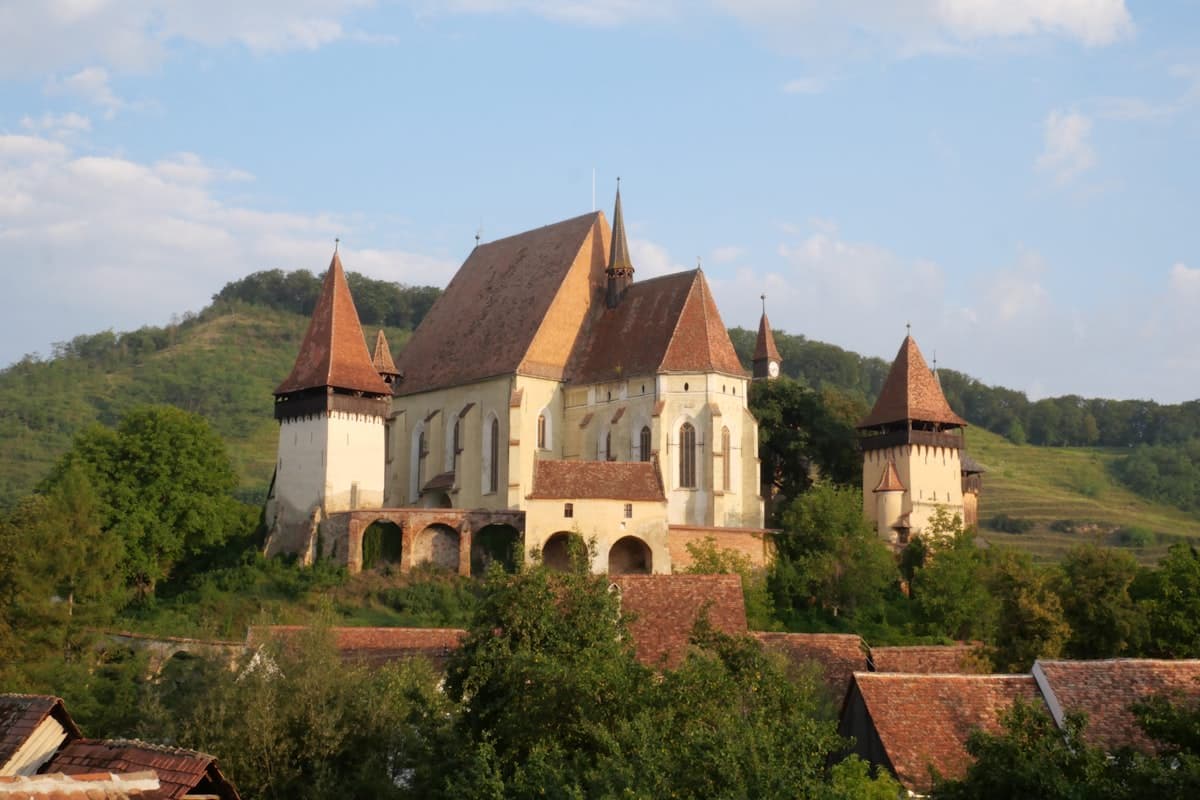
UNESCO World Heritage
Wise
Your bank marks up every USD you spend in Romania. Wise doesn't.
- No foreign transaction fees
- Free ATM withdrawals up to your limit
- Pay in local currency at the real rate
4.8 ★ App Store·4.8 ★ Google Play
Airalo eSIM
Your phone plan was built for home. This one was built for Romania.
- No SIM swapping
- No data roaming charges
- Active in minutes
4.7 ★ App Store·4.6 ★ Google Play
Health & Safety
Health & Emergency Info
Before You Travel
Before you travel check that: your destination can provide the healthcare you may need you have appropriate travel insurance for local treatment or unexpected medical evacuation This is particularly important if you have a health condition or are pregnant. Emergency medical number Dial 112 and ask for an ambulance. Contact your insurance or medical assistance company quickly if you’re referred to a medical facility for treatment. Vaccinations and health risks At least 8 weeks before your trip: check latest vaccine recommendations for Romania see where to get vaccines and whether you have to pa
Full health advice (FCDO) →Emergency Numbers
Police112
Ambulance112
Fire112
Health information sourced from UK FCDO. Always consult a travel health professional before departure.
Practical Info
Travel Essentials
Travel Guide
Frequently Asked Questions About Visiting Romania
Entry requirements vary by passport. Check the requirements for your specific passport on the Romania page at Yoogo.
Romania's official currency is the Romanian leu (RON). Card payments are widely accepted in Bucharest and larger cities, though smaller towns and rural areas often rely on cash, so it is advisable to carry lei when travelling beyond the main urban centres.
Romania is generally considered a safe destination for tourists, with low rates of violent crime in most areas. As with any European country, travellers should take standard precautions against pickpocketing in busy tourist districts and city transport, particularly in Bucharest's Old Town and on crowded public transit.
Inter-city travel is most commonly done by train (operated by CFR Calatori) or by long-distance coach, with bus services often faster and more comfortable for certain routes. Within Bucharest and other cities, public transport includes metros, trams and buses, and ride-hailing apps such as Bolt are widely available.
Late spring (May to June) and early autumn (September to October) offer the most pleasant conditions, with warm temperatures, lower rainfall and smaller crowds than the peak summer months. Summer is ideal for the Danube Delta and the Black Sea coast, while winter suits ski resorts such as Poiana Brasov and Sinaia.
Romanian is the official language, though Hungarian and German are spoken by sizeable communities in Transylvania. English is widely understood by younger Romanians and those working in tourism and hospitality, particularly in Bucharest, Brasov and Cluj-Napoca, though knowledge is more limited in rural areas.
No vaccinations are required for entry, but travellers are advised to be up to date on routine immunisations including measles-mumps-rubella and tetanus. Hepatitis A vaccination is recommended, and tick-borne encephalitis vaccination is worth discussing with a healthcare provider for those planning hiking or extended time outdoors in forested areas.
Tipping is customary and appreciated in Romania, with around 10 per cent being standard for good restaurant service. It is best to leave a cash tip directly with your server rather than adding it to a card payment, as gratuities paid by card may not reach the staff. Check the bill first, as some establishments add a service charge automatically.
Romania has excellent mobile infrastructure, with fast 4G LTE coverage across cities and reasonable rural coverage. Travellers with compatible unlocked devices can purchase a data eSIM before departure through providers such as Airalo, which routes on major Romanian networks including Orange and Vodafone. Local physical SIM cards are also available at airports and mobile network shops in most towns.