←Turkmenistan travel guide
Ahal Region, Turkmenistan
Ashgabat
The gleaming marble capital at the edge of the Karakum Desert
ArchitectureCultureHistory & Heritage
Ashgabat holds the Guinness World Record for the highest density of white marble-clad buildings in the world, with more than 540 structures finished in the material. Framed by the Kopetdag Mountains to the south and the vast Karakum Desert to the north, the city presents a striking landscape of gilded monuments, illuminated fountains, and grand Soviet-era avenues rebuilt after the catastrophic 1948 earthquake.
Check Turkmenistan visa requirements →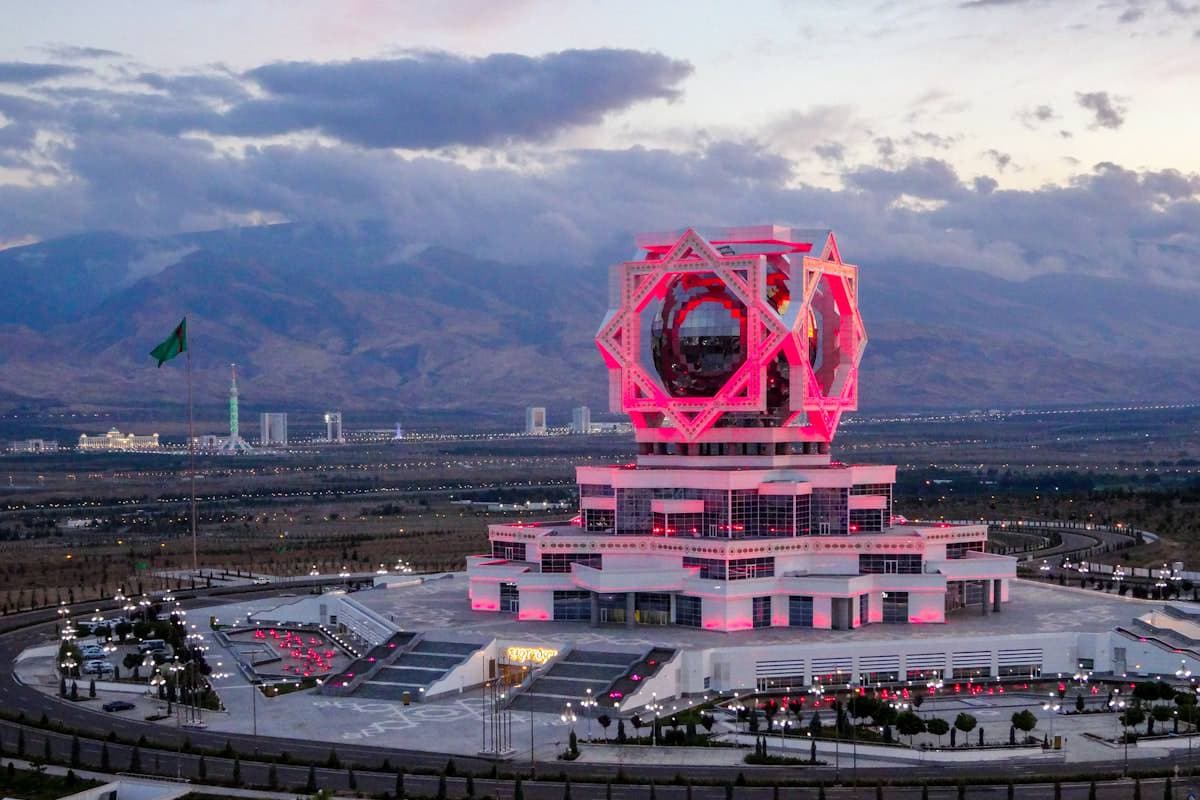
Best time to visit
April to May and September to October
Region
Ahal Region
Main airport
Ashgabat ASB (ASB)
Discover
Top Things to Do in Ashgabat
City
Ashgabat
The Turkmen capital is a surreal city of white marble buildings, golden domes, and vast monuments. Its grand boulevards and fountains hold a world record for marble-clad architecture.
Culture
National Museum of Turkmenistan
The National Museum of Turkmenistan in Ashgabat is the country's largest museum, housed in a purpose-built complex that traces the history of the region from prehistoric times through the Parthian and Silk Road eras to independence. Its collection includes artefacts recovered from Merv, Nisa, and Kunya-Urgench, alongside traditional Turkmen carpets, jewellery, and ethnographic displays. The museum provides the clearest single overview of Turkmenistan's layered cultural heritage for first-time visitors to the country.
Beyond the City
Day Trips from Ashgabat
Nature
Darvaza Gas Crater
Burning continuously for decades, the Darvaza Gas Crater, or Door to Hell, is a fiery pit in the Karakum Desert. Most visitors camp nearby to watch the flames glow against the night sky.
UNESCO World HeritageHistory
Parthian Fortresses of Nisa
The Parthian Fortresses of Nisa, inscribed as a UNESCO World Heritage Site in 2007, consist of two earthen tells known as Old Nisa and New Nisa, located just 18 kilometres southwest of Ashgabat near the village of Bagir. Founded in the 3rd century BC, Nisa served as one of the first capitals of the Parthian Empire and later as a royal residence and treasury under Mithridates I. Excavations have uncovered Hellenistic-influenced architecture, ivory rhytons, and inscribed documents that illustrate the empire's cultural crossroads between the Greek and Iranian worlds.
Wise
Your bank marks up every USD you spend in Turkmenistan. Wise doesn't.
- No foreign transaction fees
- Free ATM withdrawals up to your limit
- Pay in local currency at the real rate
4.8 ★ App Store·4.8 ★ Google Play
Airalo eSIM
Your phone plan was built for home. This one was built for Turkmenistan.
- No SIM swapping
- No data roaming charges
- Active in minutes
4.7 ★ App Store·4.6 ★ Google Play
Plan Your Trip
Getting Around Ashgabat
Tours, stays, transfers, and flights — curated partner options are on the way.
Tours & Activities
Skip-the-line tickets, guided tours, and day experiences — curated partner options are on the way.
Coming soonWhere to Stay
Hotels, apartments, and guesthouses across every neighbourhood — booking options are on the way.
Coming soonAirport Transfers
Private and shared rides between the airport and the city centre — partner options are on the way.
Coming soonFlights
Compare fares from hundreds of airlines to find the best route in — search options are on the way.
Coming soonTravel Guide
Frequently Asked Questions About Visiting Turkmenistan
Entry requirements depend on your passport. Turkmenistan is one of the world's most restricted countries for visitors, and most nationalities require a Letter of Invitation (LOI) from a registered tour company before applying. Check the specific requirements for your passport on the Turkmenistan page at Yoogo.
Turkmenistan uses the Turkmenistani manat (TMT). Cash is essential for virtually all transactions. Card acceptance is extremely limited. US dollars are the most useful foreign currency to bring. Always use authorised exchange points and retain receipts.
Turkmenistan is a highly controlled authoritarian state. While violent crime targeting tourists is rare, the government exercises extensive surveillance and restrictions on movement and photography. Travellers must generally be accompanied by a licensed guide. Follow all guidance from your tour operator and avoid photographing government buildings and military installations.
Most visitors travel with an organised tour, which typically includes private vehicle transport. Independent travel is extremely restricted. Domestic flights connect Ashgabat with other cities. Hiring a private driver through a licensed tour company is the practical approach for most itineraries.
Spring (April to May) and autumn (September to October) are the best times, with mild temperatures. Summers are extremely hot, particularly in the Karakum Desert where the Darvaza Gas Crater is located. The crater, known as the 'Door to Hell', is a draw year-round.
Turkmen is the official state language. Russian is still widely understood, especially among older generations and in business. English is rarely spoken outside the limited tourist sector. A guide who speaks English or Russian is effectively essential for most visitors.
Consult a travel health clinic before visiting Turkmenistan. Hepatitis A, typhoid, and routine vaccinations are commonly recommended. Water quality outside Ashgabat is unreliable; drink bottled water. Medical facilities are limited outside the capital.
Tipping is not a strong local tradition but is appreciated in tourist settings. Guides and drivers on organised tours typically expect a gratuity at the end of the trip. Small tips at restaurants are welcomed but not obligatory.
Internet access in Turkmenistan is heavily restricted and among the least free in the world. Many websites and services are blocked. Mobile coverage exists in cities but data speeds are slow. Foreign SIM cards may not function. Wi-Fi at hotels is available but filtered.